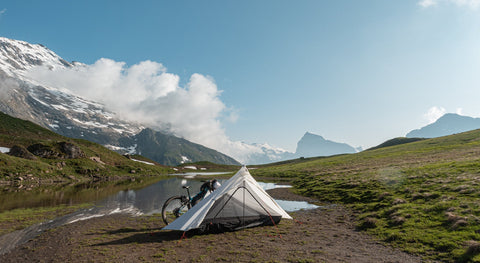
Ultra-compact and repairable tent: Fabian Furrer on Aper's APEX1
With Aper, Lucerne-based industrial designer Fabian Furrer is starting a new chapter in the outdoor world. His first product, the APEX1, is a tent developed from the ground up for bikepacking – extremely lightweight, ultra-compact, and repairable.
We were able to test a prototype of the Aper APEX1 – and we are impressed by its compact packed size, high-quality craftsmanship, and ease of handling.
Shortly after the Kickstarter launch on October 7, 2025, we spoke with Fabian about the idea behind Aper, the development of the APEX1, and his vision for the future.

Prototype of Apex1 featuring Sour Pasta Party
Fabian, what was the moment you realized there was a need for a tent developed from the ground up for bikepacking – and how did you then approach the idea for the APEX1?
There wasn't really a single specific moment. The APEX1 rather emerged from a personal design challenge I set for myself. I was curious to see if I could develop a tent structure that uses material more efficiently and thus becomes more compact when packed, without compromising on spaciousness or weather protection.
I experimented with various tent structures over many years. Again and again, I sewed prototypes, took them on bikepacking trips, tested them, and improved them step by step. It was a very playful, iterative process that I simply enjoyed a lot because you constantly learn something new and see how every small change affects the outcome.
For me, a tent is an incredibly exciting object. On one hand, it's a technical matter: how do you create a stable structure, how do you distribute tension, how do you create a robust space with as little material as possible? On the other hand, a tent also has something very emotional about it. It offers protection, security, and a piece of home in places where you actually have none. I think sleeping outdoors is still something special, almost archaic. And it was precisely this tension between technology, function, and emotional value that attracted me so much to this task.
What was long a personal design challenge has, over time and with much positive feedback from testers, become a serious project and finally the APEX1, which I am now launching with Aper.
Easy to set up
You developed your own method for measuring the compressibility of materials. Can you explain how this test works and why it is so central for you?
During material selection, I faced a very simple but crucial challenge: there is no standardized measurement for compressibility. So, when I talk to fabric suppliers about possible materials, I can't just say, "I need a fabric with a compressibility value of X."
Firstly, I was curious to understand how the different fabrics in the tent, i.e., outer tent, floor, or mosquito net, actually behave. Secondly, I needed to develop a method to make these differences measurable and comparable at all.
That's why I set up my own test, which is as close as possible to real conditions. The basis was the included compression bag with a diameter of about 10 cm. I assumed a maximum pressure of around 60 kilograms, which is what happens when you lean on the packed tent with your body weight. I divided this maximum value into four stages: 15 kg, 30 kg, 45 kg, and 60 kg. I transferred these forces to a smaller cylinder, in which the fabric is clamped and compressed with a defined pressure piston.
This allowed me not only to determine how much a fabric can be maximally compressed, but also how quickly it collapses under pressure. This was an important point, because a fabric that compresses easily and evenly is also more pleasant to handle in everyday life, for example, when you simply stuff the tent back into its pack sack.
Through many series of measurements, I was then able to narrow down which materials generally have the greatest potential. Of course, the thickness of the fabric plays a role, but an equally great influence comes from the coating, its thickness and type. A PU coating behaves quite differently from a silicone coating, and the weave structure, i.e., how dense the fabric is or how large the ripstop grid, also significantly influences the result.
As a result of this work, I now use a 20-denier fabric with silicone coating for the APEX1, which compresses as well as a 10-denier fabric, meaning with half the yarn strength, but at the same time offers the tear resistance and robustness of a classic 20-denier fabric. This combines durability with high compressibility.

With the APEX1, you rely on undyed fabrics and sewn instead of glued seams. What role do sustainability and repairability play for you personally and for Aper as a brand?
Sustainability plays a big role for me, but I see it very practically. Every product has a CO₂ footprint in manufacturing, that cannot be avoided. For me, the crucial factor is how this initial footprint is distributed over the lifespan, i.e., the footprint per use. Even with ultralight tents, longevity is a central factor to truly justify the ecological effort of manufacturing.
From my experience with life cycle analysis programs like the Higg Index, I know that the use of recycled materials generally has a positive effect on the initial footprint. However, these tools do not show how a potentially shorter lifespan affects the actual footprint per use. If a fabric is less tear-resistant and the product therefore has to be replaced earlier, the overall effect can quickly reverse.
That's why I pursue a pragmatic approach at Aper: measures that extend the lifespan take precedence. With the APEX1, the outer tent is undyed, which improves the CO₂ balance in production by around 30 percent without affecting performance. And thanks to the material and seam construction, the tent is also particularly durable.
The seams are waterproof, even though they are not taped. This is made possible by a combination of double-sided silicone coating, impregnated thread, and optimally chosen needle size. When the sewing needle pierces the fabric, the silicone immediately reseals around the thread, similar to a tire plug on a bicycle. This makes the seam sufficiently tight, without additional seam-sealing or taping, which often lead to weak points, especially with frequent compression.
This results in a durable, repairable product with an improved footprint, where every detail is designed to maximize lifespan and sensibly distribute the ecological effort over many years.

The tent was tested in races like the Silk Road Mountain Race and by well-known bikepackers. Which insights from these deployments most strongly influenced the final design?
In the Silk Road Mountain Race, where Alex Kopp finished in the top 10, the tent had to be easy to handle, reliably protect, and ensure restful nights, and it performed very well in all these aspects. His feedback after the Silk Road Mountain Race was consistently positive. Accordingly, there were no fundamental changes to the structure or dimensions. However, we made a small adjustment: the floor was pulled up a bit higher at the back to provide even better wind and splash protection in heavy rain. Even when the tent was frozen in the morning, it held its tension excellently, which was a nice confirmation of the construction's stability.
Your Kickstarter campaign launched on October 7. What can supporters specifically expect – and what is your vision for Aper beyond the APEX1?
The campaign is now running, and it's incredibly rewarding to see how much positive feedback has already come in. Now that more pictures, videos, and background information are out, hopefully people will also get a sense of who is behind the project and that the tent is truly made by bikepackers for bikepackers. That was the idea from the beginning.
With Aper, I want to build a brand that is very close to the community. For me, this means not developing things in isolation, but staying transparent, sharing experiences, and letting people participate in this process. I believe that's how the best products are created – when you develop them together with the people who will actually use them later.
The APEX1 is just the beginning. The vision is to use the learnings from this development to create more tents that are just as well-thought-out and compact, and to build a tent brand that consistently specializes in the needs of bike travelers.
---
Thank you, Fabian, for the conversation and the exciting insight into the development of the APEX1. If you would like to support the project, you can find all information and the start of the Kickstarter campaign on Kickstarter.

About Fabian Furrer:
The Lucerne-based industrial designer has over ten years of experience in the outdoor industry and was previously Design Lead at Mammut. With Aper, he combines his professional expertise with his passion for long bikepacking adventures.
Unsere Brands